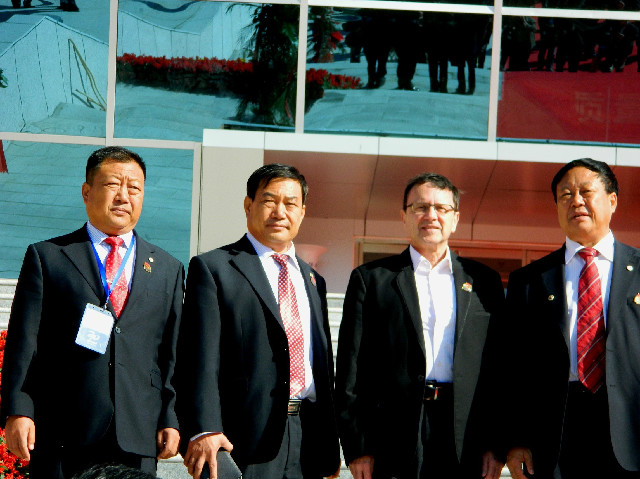

Sun Dawu 孙大午 on October 28, 2020 or two weeks before his arrest
"从农民到私营企业制度的制定者。"
"A Farmer becomes the Framer of the Private Enterprise System"
狄·卡尔顿·罗西 © March 03, 2026

The A Frame-Line of Sennedjem
"Servant in the Place of Truth" during the reigns of Seti I and Ramesses II
THE STELLAR QUADRATURE MODEL ©
In the eighteenth dynasty
of Hatshepsut's reign, the NCP was in a particularly "empty" region of
the sky, roughly halfway between the former pole star (Thuban) and the
current one (Polaris). Using a two-stage horizontal leveling like this
would allow a surveyor to:
1. Mark a baseline when Kochab and Pherkad are level.
2. Confirm the meridian an hour later when Zeta and Eta are level.
If
the center point of both measurements remained identical, the surveyor
could be confident they had found the true, invisible North.

The stars point to Ta Sun 太尊 or the "Royals" asterism in the Purple Forbidden Enclosure.
DUAL TRANSIT
THE PROCESSIONAL ASTRONOMIC
GNOMON
The Sky in 1470 BCE
Because the pole of the
Earth was tilted toward a different point, the newly discovered scalene
triangle known as the Processional Astronomic Gnomon in the Great Bear
functioned as a highly accurate "precessional" clock. If an Egyptian architect
"stretched the cord" along the triangle's axis in 1470 BCE, the lines
were projected into the Little Dipper's bowl with an entirely different
geometry compared to today.
The Necessary Balance of
Order and Disorder

Hatshepsut sphinx at Met. Museum
This file is made available under the Creative Commons CC0 1.0 Universal Public Domain Dedication through Wikipedia.
The
symbol of the Great Sphinx dates back at least to around the time of
Pharaoh Khafre in the Old Kingdom. The year was around 2500 BCE which
marked the time of pyramid building. The Sphinx served a ceremonial and
protective role by acting as a guardian of funerary complexes.
Khafre
believed his soul would ascend to the star Sirius known as Sopdet. It
is the brightest star in the night sky. It was associated with the
goddess Isis who symbolized rebirth and regeneration.
It is
generally accepted that the Great Sphinx is not an imaginary concept. It
emerges from a combination of historical significance, cultural
symbolism and mythology. Its existence reflects the values and beliefs
ot its creators. This means it is a profound emblem rather than a mere
figment of imagination. This is a block description.

"Compact Geometry"
D. Carlton Rossi © 2026
The Giza trio mapped onto the circumpolar stars turns the celestial "fixed"north into a dynamic engine of rejuvenation and fertility. Each of the three crystalline obelisks are topped by a pyramid.
The Giza trio mapped onto the circumpolar stars turns the celestial "fixed"north into a dynamic engine of rejuvenation and fertility. Each of the three crystalline obelisks are topped by a pyramid.
Description
Description
The obelisks are stretched between the Little Dipper (Ursa Minor) and the Big Dipper (Ursa Major) anchoring the structures to the very "axle" of the sky. By aligning Khufu with the center axis on Megrez and its flank on Phecda creates a rigid, geometric link to the "bowl" of the Great Bear. Targeting the center axis on Thuban (the former North pole star in the Draco Constellation invokes the "Old Kingdom" era when these pyramids were actually built effectively to sync the structures with their original stellar clock. By casting Menkare as a "shoot" of raw potential at the 51-52 degree slope (the actual slope of the Great Pyramid, the "spent" stability of the old monuments is contrasted with a rising generative force. The shared center between the Khufu and Khafre obelisks suggest a unified consciousness from which the younger, more potent Menkaure breaks away to initiate a new cycle.
The obelisks are stretched between the Little Dipper (Ursa Minor) and the Big Dipper (Ursa Major) anchoring the structures to the very "axle" of the sky. By aligning Khufu with the center axis on Megrez and its flank on Phecda creates a rigid, geometric link to the "bowl" of the Great Bear. Targeting the center axis on Thuban (the former North pole star in the Draco Constellation invokes the "Old Kingdom" era when these pyramids were actually built effectively to sync the structures with their original stellar clock. By casting Menkare as a "shoot" of raw potential at the 51-52 degree slope (the actual slope of the Great Pyramid, the "spent" stability of the old monuments is contrasted with a rising generative force. The shared center between the Khufu and Khafre obelisks suggest a unified consciousness from which the younger, more potent Menkaure breaks away to initiate a new cycle.
Cycle de Lumière
Toujours
jour tour
jour après jour
son éclat quotidien naît
poulain enflammé se cabre ciel
soleil illustre brille, midi jour zénith
deux heures après son ombre s'allonge
doux période suivant est tranquille
soleil seul sol seule
le jour tournant
lumière s'amenuise
sol
狄·卡尔顿·罗西 D. Carlton Rossi
© 2026

Mao Yushi 毛雨诗 UNIRULE 天则经济研究所
祝毛玉熙97岁生日快乐!
Happy 97th Birthday Anniversary to Mao Yushi!

MAO Yushi, HONG Sheng: The Peach Tree
毛,洪: 桃树
The Unirule Institute of Economics (天则经济研究所); Tiānzé Jīngjǐ Yánjiūsuǒ)
UNIRULE was founded in July 1993. It was located in Zhongguancun, Beijing which is often referred to as "China's Silicon Valley". This was about 3-5 kilometers away from the Chinese Academy of Sciences (CAS) where D. Carlton Rossi taught doctoral students in 1993 and onward. The proximity of UNIRULE to CAS facilitated collaboration and interaction between the two institutions, especially in research and policy discussions. MAO Yushi, HONG Sheng were two of the original founders. Both played important roles in shaping economic policies among government officials and social discourse with the public.
Note: On their website, Unirule is translated as "Tianze". It says “Unirule” (or “Tianze” in Chinese) is a name with its meaning originally stemming from the words in Shi Jing, an ancient Chinese [Book of Songs], which says: “as the universe is created by the God, there have to be rules for it”. Thus, “Unirule” stands for Universal rules that in reality govern economic and other fields."

孙大午 : 大尊 天空的 狮头人像
(© D. Carlton Rossi November 07, 2025)
Sun Dawu : The Extremely Honourable Celstial Sphinx
(© D. Carlton Rossi November 07, 2025)
(Note: all previous iterations are also copyrighted)
Ta4 Tsun1 (Wade-Giles) Tian1 Kong1 de Shi1 Tou2 Ren2 Xiang4
One of the stars called (大尊) or Psi Ursae Majoris of the Great Bear Constellation is located on the far left. Allen interpreted 大尊 to mean “extremely honorable” by using the Wade-Gilles system. It was formerly one of the Royals in a Chinese constellation called Wuanyuan or Yellow Emperor. Psi Ursae Majoris points directly to the Alpha star called Regulus which is at the heart of the modern constellation called Leo.
Allen, Richard Hinckley, Ursa Major, Dover Publications, University of Chicago: 1899.
This poem or l'image© is part of The Elegant Celestial Giza Series©.
For special purposes, the poet has classified this poem as Chinese. It is Chinese because the poet originally drew a version of it in 2014 while in China. It is Chinese because it is dedicated to SUN Dawu 孙大午 or The Great Noon. It is Chinese because the title 孙大午: 大尊 天空的 狮头人像© is in Chinese. However, the most important reason is because the I'mage© includes a special star. This star which is visible to the naked eye is outside of the Big and Little Dipper asterisms as well as the Pole Star known as 11 Draconis (Flamsteed designation) or Thuban. The star is Psi Ursae Majoris (大尊) within the Great Bear Constellation. This star is located at the tip of the paw. The name was possibly derived from the word 太尊, Tàizūn, meaning Royals, because this star stands alone as the only member of the Royals asterism within the Purple Forbidden enclosure. This I'mage © is the only one in the Great Bear Constellation as opposed to the Draco Constellation. The I'mage © symbolizes the Chinese and now universal Mandate of Heaven.

刘会茹 觉醒至虚空
LIU Huiru: Awakening to the Void
(D. Carlton Rossi, copyright 2024-2025)

孙大午:从“官渡之战”谈能力•道德•胸怀
April 07, 2020
Republished 10月16日 11:30 来自 微博 weibo.com
社会上有能力的人多,有道德的人少,有道德又有胸怀的人更少。所以有能力的人要修身,提高自己的道德修养和道德水准,有道德的人要提高自己的胸怀。所以,挣钱靠能力、发展靠道德,要干事业靠胸怀。
There are many capable people in society, few people with morality, and even fewer people with morality and mind. Therefore, capable people should cultivate their moral character and improve their moral standards and those with morality should improve their minds. Therefore, earning money depends on ability, development depends on morality, and career depends on mind.

SUN Dawu 孙大午 Dawu Group 大午集团
Discover how Sun Dawu 孙大午
combines Confucian values,
legal principles and socialist ideals
to shape a unique corporate culture
at Dawu Group in Langwuzhuang.
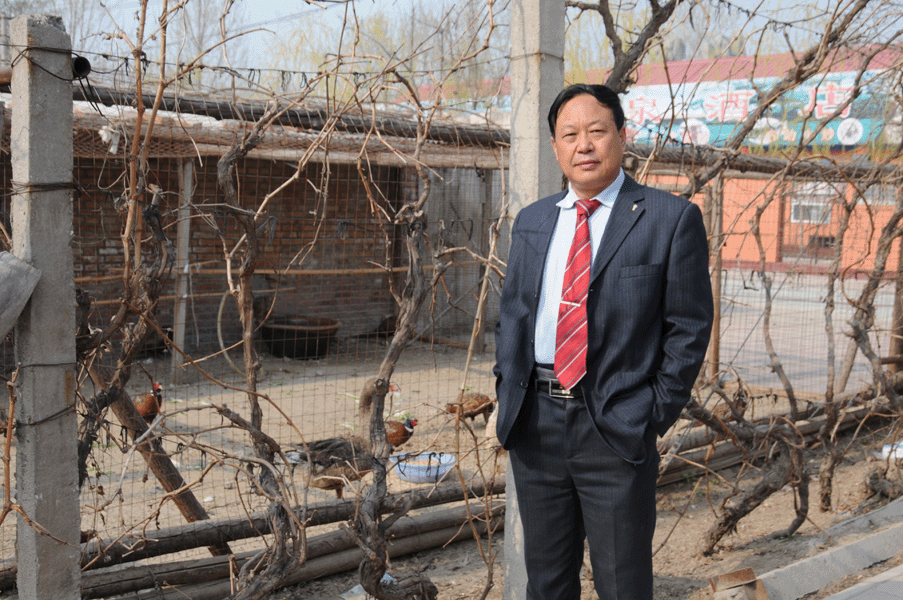
Sun Dawu 孙大午 Dawu Group 大午集团

Sun Dawu photographed this scene on December 16, 2017 as posted on Facebook. Liu Huiru plays The Halusi 葫蘆絲 or Gourd Flute in a traditional band at a small Confucian temple in Dawu City.

Jorgen Delman
Nordic Institute of Asian Studies, University of Copenhagen
Xiaoqing Yin, Nanjing Normal University

Second Appeal of Sun Dawu 孙大午
A REUTERS SPECIAL REPORT
A billionaire pig farmer fights his conviction from behind bars as tycoons face crackdown in China
By DAVID LAGUE
Sept. 10, 2024
In a handwritten submission from his prison in rural northern China, billionaire pig and chicken farmer Sun Dawu implored the court to hear his appeal. He was serving an 18-year sentence on charges including corruption. There was far more at stake than his own unjust conviction, the 70-year-old tycoon wrote in his Nov. 16 plea.
Without his leadership, the business he’d built for decades would collapse, he warned. His company, Hebei Dawu Agriculture and Animal Husbandry Group, had more than ten thousand employees.
If his appeal was delayed, “the enterprise will be completely wrecked,” he wrote in the legal document, seen by Reuters. “I don’t think this is what leaders of the court, party committees and governments at all levels want to see.”
https://www.reuters.com/investigates/special-report/china-economy-crackdown-tycoons/

SUN Dawu 孙大午 D. Carlton Rossi 狄·卡尔顿·罗西


大午集团 Dawu Group


Our Unique Services
Discover the distinct services that define Dawu Group's commitment to excellence.
Community Development
Corporate Governance
Goals
SUN Dawu vows loyalty to the CCP as he promotes a private entrepreneurial constitutional system accompanied by social redistribution.

大午集团 Dawu Group
Harmony Through Tradition, Law and Prosperity
At Dawu Group, our essence lies in the fusion of ancient Confucian ideals, modern legal principles, and socialist visions of shared prosperity. The Great Noon's vision shapes our corporate culture, blending tradition, rule of law, and common wealth. We strive for harmony and growth, guided by timeless wisdom and contemporary governance, towards a future of collective success.

Dawu Group 大午集团
Sun wants to establish an ideal city-state which will serve as a model for the rest of China. It is founded upon practical Confucian principles which have formed the basis of Chinese society and family for thousands of years. His goal is to transform a rural community based on agriculture to a civilized city-state (based upon culture) which has Chinese and international characteristics. Specifically, he wishes to improve the quality of life for farmers and peasants by job creation.

Mosaic of Sun Dawu 孙大午 Dawu Group 大午集团
Dawu Group
Discover the unique values that set us apart in the industry.
Cultural Foundation
Commitment to Law
Community Focus
Proven Leadership

Sun Dawu 孙大午 Dawu Group 大午集团
Frequently Asked Questions
Common inquiries about Dawu Group's values and practices.
What is the corporate culture of Dawu Group?
How does Confucianism influence your operations?
What is meant by 'socialist common prosperity'?
Join Us in Building a Harmonious Future
Embrace the fusion of Confucian values, modern law, and socialist ideals at Dawu Group. Let's work together towards shared prosperity and ethical business practices.