祝毛玉熙97岁生日快乐! 
  
Happy 97th Birthday Anniversary to Mao Yushi!

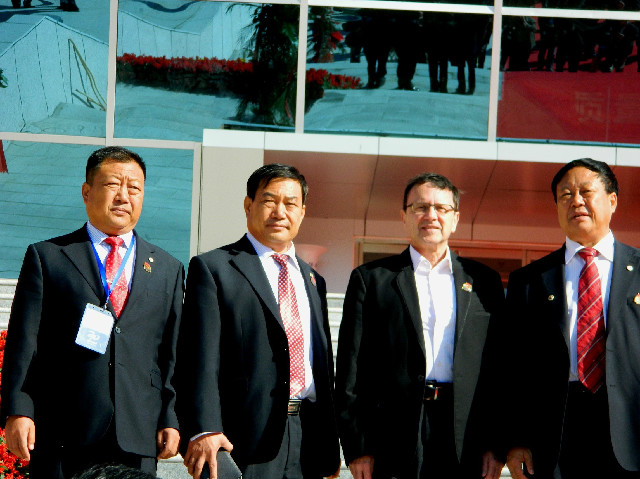
Mao Yushi on far right

The Unirule Institute of Economics (天则经济研究所); Tiānzé Jīngjǐ Yánjiūsuǒ) 

UNIRULE was founded in July 1993. It was located in Zhongguancun, Beijing which is often referred to as "China's Silicon Valley". This was about 3-5 kilometers away from the Chinese Academy of Sciences (CAS) where D. Carlton Rossi  taught doctoral students in 1993 and onward. The proximity of UNIRULE to CAS facilitated collaboration and interaction between the two institutions, especially in research and policy discussions. MAO Yushi, HONG Sheng were two of the original founders. Both played important roles in shaping economic policies among government officials and social discourse with the public.  

Note: On their website, Unirule is translated as "Tianze". It says  “Unirule” (or “Tianze” in Chinese) is a name with its meaning originally stemming from the words in Shi Jing, an ancient Chinese [Book of Songs], which says: “as the universe is created by the God, there have to be rules for it”. Thus, “Unirule” stands for Universal rules that in reality govern economic and other fields." 

Perhaps the poem below is the one referred to from the Shi Jing or Book of Songs. 
 
关雎 (Guan Ju) 

"窈窕淑女,君子好逑。"
"如切如磋,如琢如磨。"
"天命玄鸟,亿兆斯年。"
"人之所命,德之所厚。"


"Graceful and virtuous lady, the gentleman cherishes her."
"Like cutting and polishing, like carving and grinding."
"The mysterious bird of heaven, its fate spans thousands of years."
"Human destiny is governed by virtue."


The poem emphasizes the virtues of love and relationships, likening them to the processes of refining and perfecting something valuable. It suggests that just as the universe is created with inherent rules and order, human relationships are guided by moral virtues and mutual respect. The reference to "天命" (the mandate or order of heaven) underscores the belief in a higher moral order governing existence.


Sheng Hong: The Name of Unirule is very suitable

translation of unknown date


oooooooooooooo
 
When Unirule was created, we were not aware of the classical usage of “Unirule”, as we just used “Unirule” as a short version of “rules between Heaven and Earth”. It sounded suitable, and was consistent with our passion for institutional economics and concern with institutional change. Afterwards, in The Book of Songs, we found the poem “Tian Sheng Zheng Min, You Wu You Ze”, which means “People are created by God, and naturally there would be  things and rules”. That is suitable for our understanding of institutions: in human society, institutions would be generated naturally, and they are the spontaneous order.

222

Later, in The Book of Changes we found the sentence “Qian Yuan Yong Jiu, Nai Jian Tian Ze”, in which we first found the classical usage of “Unirule” as a whole word. As Mr. Nan Huaijin explained, the sentence means that Heaven and Earth generated rules, never demanding return, which was precisely our definition of Unirule and very close to our ambition.

333

After reading more literature, we found that this sentence is a classical one, commented and discussed by ancient scholars of past ages. In the  Song Dynasty, Yu Yan said, “Unirule is natural law” and “the natural law has no mind”. Yang Jian said “Unirule means God’s activity, and human activity is not Unirule”. That is to say, there exist the ways of Heaven, which are beyond the wisdom of human beings. Only by trial and error can human beings understand Unirule and follow the way of Heaven.

444

Nevertheless, people should not give up exploring “Unirule”, not only because of curiosity of human beings, but also because in that kind of society where the ways of Heaven are followed by people as well as they can, everyone will feel happier and the whole society will be more prosperous. To comply with the ways of Heaven is the origin of Chinese civilization. Exploring “Unirule” becomes their everlasting task, for it is beyond the wisdom of human beings. So, Unirule Institute of Economics researches institutions and cultures, which is a modern continuation of this ancient and perpetual cause.

555

Furthermore, since Unirule are the rules beyond human beings’ wisdom, the reality of human society is always flawed, and the individuals within the political structure are facing limitations. To overcome this problem, we should first acknowledge the infinity of Unirule as well as the limitation of secular government and its specific political figures. Then we should explore an institutional structure to hamper the secular government and the specific political figures and amplify the virtue of each society member. This kind of approach is constitutionalism.

666

It is generally believed that constitutionalism originated in the West and plays an important role in Christian tradition. If not complying with the “Justice of God”, the secular government has no legitimacy. Similarly, the ways of Heaven and Unirule have given us the spiritual resource of constitutionalism. The emperor was regarded as an official, who should be guided and constrained by the ways of Heaven. 

777

Therefore, there should be someone who has a deeper understanding of the ways of Heaven than other individuals and groups. Heaven shows the signs, and sages transform them into rules.” By understanding the ways of Heaven through nature's inspiration then cultural traditions are formed. The group who bears the tradition, as Mr. Yu Yingshi said, was recognized gradually as representative of the traditional ways of Heaven since 4th century BCE by political groups. 

888

Accordingly, the name of Unirule also contains constitutionalism. After the Cultural Revolution, the structure of integration of politics and God has collapsed. The government appeared to be more secular, and also the political figures return to be ordinary persons The ideal political structure should be a set of constitutional principles. To the whole society, it contains basic principles concluded from successes and failures of thousands of years, including principles of protecting human rights and property rights. In the political area, it is the constraint to the defects of the secular government and political figures; as well as, the encouragement for people to promote social justice and prosperity. However, it is neither easy to explore the set of constitutional principles nor explore the ways of Heaven, for it is necessary to absorb and digest varied kinds of spiritual resources at all times and in all countries.

999

Of course, the cultured elites are also ordinary people; so, there should be way to explore the ways of Heaven. Those are rules of freedom of expression and civilized debate. It can’t be denied that heroes appeared in history, which precisely happened as a result of following the rules. Thus, Unirule Institute of Economics could not regard what we say are the ways of Heaven only because our name is Unirule, and we should try our best to maintain the rules of freedom of expression and civilized debate, promoting the constitutional consensus with various cultural elites.


10101

Based on this, Unirule will try its best to rebuild social, moral value and let the social and political fields benefit from it. We hope that the secular government and political figures should acknowledge that they are also ordinary people, and accept the constitutional principles which are far beyond the interests of individuals and groups. What we would like is that as Xun Zi’s saying, improving politics when in the government, while improving morality when in countryside. We would like to tell society and government what we regard as constitutional principles through our papers, books, and reports; while to tell the public what kinds of moral values we pursue through our essays and micro-blogs.


1111

Take a look at the past twenty-four years at what we have done and will do. It can be summed up in one word ”Unirule”.


Poe-Phi interprets the number sequence in the following philosophical way:  

00000000000000 represents state of emptiness or potential. It might represent the void from which all things emerge.

222 means balance and harmony. It can also signify partnership and duality reflecting interconnectedness.

333 frequently signifies growth and creativity. It might represent the synthesis of ideas and philosophies. 

444 represents stability and strong foundation. The necessity to ground theories in practical realities.

555 is typically associated with change and transformation. This could align with disruptive innovations in economics or societal shifts in philosophy.

666 is often misunderstood. It can represent materialism or imbalance. In some contexts, it invites reflection on ethical implications in economics. 

777  is seen as a spiritual or mystical number; it could denote higher wisdom or enlightenment.

888 is often linked to abundance and prosperity.  It may reflect success in both economics and philosophical pursuits. 

999 symbolized completion or the end of a cycle. It may be a culmination of ideas or periods of philosophical thought. 

101101 may mean a breakthrough or new beginning as it combines simple patterns with complexity. 

1111 is commonly seen as a sign of awakening. It may signal the need for self-awareness in philosophical and economic endeavours. 


History

UNIRULE was a prominent think-tank in the country's economic reform and policy development. It focused on advocating for free-market principles and economic liberalization. Its experts provided research and policy recommendations to promote reform that favoured market competition and private ownership.  

The think-tank 智库 was influential in Beijing's policy discussions. These took place during significant economic transitions throughout the late 1990's and early 2000's. It contributed ideas that shaped debates on privatization and regulatory frameworks. 


https://web.archive.org/web/20040102110549/http://www.unirule.org.cn/                        (Chinese)

https://web.archive.org/web/20031210133529/http://www.unirule.org.cn/unirule.htm       (English)

http://english.unirule.cloud/    (English)


D. Carlton Rossi merely expresses an opinion that the concept of  "Zhong-Zheng" (中-正)  may parallel UNIRULE in its philosophy.   A hyphenated term is a unique way of expressing the concept of central-correct. For philosophical alignment, "Zhong-Zheng" translates to "central righteousness" or "justice," because the organization's focus is on governance and ethical standards in economic policies. The term resonates within the context of Chinese political philosophy, too, emphasizing balance, integrity, and the well-being of society, which are often core tenets of discussions and reforms initiated at UNIRULE.  Finally, the name may reflect the organization's objectives and ideologies, which emphasize a moral and fair approach to governance and public administration.

It is ironic that this poet will concentrate mostly on the meaning of "Zhong-Zheng" in its philosophical sense rather than its poetic sense. The reason is that he regards himself as a poet-philosopher or PoePhi. In this case, he is examining the Chan Buddhist philosophy of Ming Zhiqiang (明知強) because he himself is a Zen philosopher and his views are attune to Ming's philosophic concept of Shuāng Chán which blends similarities of Buddhism, Confucianism and Daoism (BCD). PoePhi also sees geometric patterns of harmony and balance in the Big Dipper, Little Dipper and Pole Star as does Ming Zhiqiang. These patterns are expressed in PoePhi's I'mage poems which convey philosophic content. 


    中 (Zhong): Means "central" or "middle," often associated with balance and moderation.

    正 (Zheng): Means "correct" or "righteous," indicating moral integrity and the pursuit of justice.

In the context of the UNIRULE organization, the term may reflect an emphasis on balanced decision-making and just governance, aligning with Confucian values that advocate for ethical leadership and social harmony.

In his writings, Ming linked something like “Zhong-Zheng” (中-正) to ideas of balance and moral integrity in Chan Buddhism as shown in the following examples. 

“修道者需持中正之心,方能明心见性。”

“A practitioner must maintain a heart of centrality and righteousness in order to achieve clarity of mind and realization of nature.”

    
 “中正是禅修的根本,非但体现在行止,亦在内心。”

“Centrality and righteousness are the foundation of Chan practice, not only manifesting in actions but also within the heart.”

In these writings, Ming Zhiqiang emphasizes the importance of balancing personal conduct and inner virtue in the practice of Chan Buddhism 禅宗, showcasing how these principles intersect with broader philosophical discussions.

Ming Zhiqiang also recognized similarities among Buddhism, Confucianism and Daoism. The Chan Buddhist blended these philosophies into Shuāng Chán. This term literally translates to "double Chan," suggesting a dual non-dual perspective in meditation practice. This interpretation suggests that while there may appear to be dualities in meditation (such as thoughts vs. stillness), they ultimately lead to a unified understanding of reality. Therefore, one might translate the phrase Shuāng Chán in a nuanced way as (双馋)"Dual Chan".  If one doesn't mind a bit of humour then "think-tank" becomes "meditation-tank" which is admittedly less practical in an economic and real-world sense. 

Ming Zhiqiang highlighted how these three traditions share common philosophical themes; such as, the emphasis on moral values, ethical behaviour, and the pursuit of harmony in life. Through his work, he aimed to explore the interactions and dialogues between these schools of thought by recognizing their respective contributions to Chinese culture and spirituality. He believed that understanding these similarities could foster a more integrative approach to Chinese philosophy. 

To celebrate Mao Yushi's birthday anniversary and his permanent stay in Canada, the poet has designed a new celestial-terrestrial I'mage called MAO Yushi, HONG Sheng: The Peach Tree (毛,洪: 桃树).MAO Yushi and HONG Sheng were two of the original founders of UNIRULE in July 1993. In Chinese culture, the Peach Tree is especially significant. It symbolizes longevity and immortality, meaning it is linked with the realm of humans and the gods. The sacred peach of immortality is often associated wit the Queen Mother of the West (Xi Wangmu) 西王母. In other cultures, it may be recognized as The Tree of Life 生命之树 or Axis Mundi 世界轴. 

SUN Dawu as an entrepreneur and advocate for rural development has often spoken about the concept of a "peach garden" as a metaphor for an ideal community or utopia.  The "peach garden" symbolizes a harmonius and prosperous community where people live in peace and mutual support.  Sun emphasizes the importance of creating sustainable and economically viable rural areas that can thrive outside major urban centers. His vision encompasses social and environmental responsibilities urging collective efforts to improve livelihoods of rural populations. The "peach garden" reflects broader utopian ideals where social equity, environmental sustainability and community spirit coexist. 

As a poet, I like to present this "I'mage" (我多少个世纪) or sketch (素描)as a unique kind of didactic, dialectic poetry based on dynamic Platonic shades and resonances “基于动态的柏拉图色调和共鸣的教学性、辩证诗歌孙大午"  This genre of image-based poetry 基于图像的诗歌 is characterized by its educational purpose focusing on moral instruction through philosophy while simultaneously engaging in explorations of varied viewpoints or truths. This may challenge the viewer to think critically about the subjects presented. 

The field is small, but there are other artists who classify their paintings as poems. For example, Paul Klee often described his work as "visual poetry". He sought to express emotional and abstract concepts through color and form. The art of Gustav Klimt embodies poetic qualities, especially in works like "The Kiss". Niki de Saint Phalle refers to her art as a kind of poetry because her colorful sculptures and paintings tell a story through vivid imagery and symbolism. One notable Chinese artist and poet was Wang Wei (王维) in the Tang Dynasty who practiced "Shan-Shui" or mountain- water style "山水". He often integrated his poems with paintings suggesting that the essence of his artwork could be understood as a poem in visual form. Finally, an inspiration for me is William Blake 威廉·布莱克. He allowed his paintings and engravings to be dually classified as poems. The famous engraving of "Urizen" 尤里岑 who represents reason and law creates a profound sense of awe and contemplation. 

It seems appropriate if reference is made to Ming Zhiqiang's (明知强) "Essentials of Chan Practice" (禅修要义). The exact year of his writings is often debated, but it is commonly situated during the late Ming Dynasty at the end of the 16th century. He resided in the capital at the time or Nanjing (the birthplace of Mao Yushi). The reigning ruler at that time was Emperor Wanli (万历帝).

 作者: 明知强
书名: 《禅修要义》
 出版年份: 明朝晚期(约十六世纪末)
 皇帝名: 万历帝

There are several reasons Zhiqiang's "Essentials of Chan Practice" will be referenced besides those already mentioned. Ming Zhiqiang does include references in his writings to star maps, particularly focusing on the Big Dipper 大熊座, Little Dipper 小熊座 and Pole Star 北极星.However, specific visual star maps are not definitively attributed to him in surviving texts. Second, he often describes the positions and significance of these stars verbally, using them to illustrate moral and philosophical concepts rather than providing detailed diagrams. Third, his work is situated within the broader context of Chinese astronomy, where star positions were commonly studied and documented; so, he may reference established maps or celestial arrangements. Next, while he may not provide original star maps, he likely draws from the rich tradition of Chinese astronomical literature, which did include star maps depicting celestial formations. Finally, there is a practical and scientific reason to refer to his "Essentials of Chan Practice" 

There is a notable armillary sphere 臂圈天球仪 in Nanjing.  An armillary sphere is a classical astronomical instrument used to represent the celestial sphere and its various components, such as the equator, ecliptic, and celestial poles. By adjusting the rings to match the observer's latitude and the current date, astronomers could align the instrument to accurately reflect the position of the North Star in the sky.

This armillary sphere was constructed in 1383, during the early Ming Dynasty. The Yongle Emperor, Zhu Di commissioned it.  It is often referred to as the "Imperial Armillary Sphere" (皇极天文仪). This name emphasizes its connection to imperial astronomy and the efforts made under Ming rulers to advance astronomical understanding. It is probable that Mao Yushi as a young, trained mechanical engineer has seen this museum masterpiece in Nanjing.  

Guo Shoujing's (郭守敬) earlier version of the armillary sphere incorporated advancements in design and accuracy, but was a simpler design. It laid foundational knowledge for the final version of the armillary sphere after his death. He was a prominent astronomer known for his advancements in astronomy and calendar making. He is known for the "Zhiwei Yutu" map 《直纬地图》which illustrates the position of stars and other celestial bodies. His greatest advancement in astronomy was the improvement of the water clock "clepsydra" 水钟 and the establishment of a more accurate system for measuring time through the use of the "sundial" 日晷.  

One might contrast Guo Shoujing with Ming Zhiqiang. Guo (January 16, 1231-September 09, 1316) was a practical engineer who built things. He commissioned the earlier version of the armillary sphere in Nanjing. He improved the water clock and sundial. As a hydraulic engineer during the Yuan Dynasty, his innovations in excavation and water diversion were later applied by others during the Ming Dynasty. Travelling throughout China, he made detailed terrestrial and celestial maps.

On the other hand, Ming Zhiqiang was a dreamer who resided in Nanjing at the time of the Emperor Wanli. He was a practicing Chan Buddhist monk of the Linji school founded by Linji Yixuan in the late Tang Dynasty. His teachings emphasized personal enlightenment and self-realization. Ming examined the stars for moral lessons where he envisioned basic, geometric shapes. He may have interpreted worldly pursuits as mere dreams, fostering a perspective that highlighted the transient nature of life. Basically, he focused on spiritual ideals rather than tangible realities.  

The temple where Ming Zhiqiang served is called John's Temple. It still exists in Nanjing as the "Jiangning Zhijiang Temple". It is known for its historical significance and its role in spreading Buddhism during the Ming Dynasty. 

To some extent, this contrast between men and missions can be applied to UNIRULE and even to myself. While there was a basic premise that laws should be universal; nevertheless, the emphasis was placed on practical applications of the legal, regulatory framework to build a strong economy from the bottom up which would benefit, in a utilitarian way, the greatest number of people. It advocated for a free market economy and democracy in a largely state-controlled discourse. 

Then, cruel reality set in. In August 2019, UNIRULE was officially shut down. The image that was seared into my brain was the welding of the doors to UNIRULE from the outside with employees in the inside. The closure was part of a broader crackdown on independent organizations like think-tanks that advocated for economic liberalization and democratic ideas which clashed with the Chinese Communist Party's control over political discourse and policy. Are worldly pursuits mere dreams for people and party?

A similar situation was faced by private businesses like Dawu Group which placed people over profit. This enterprise which began from humble beginnings succeeded despite all the government regulations and restrictions. It provided social benefits that the government only talked about. Its experimental model of a Private Entrepreneurial Constitutional System was suitable for Dawu Village and rural China. 

However, the Xiongan New Area was announced in April 2017. It was part of a broader strategy to integrate Beijing, Tianjin and Hebei into a cohesive economic zone, enhancing connectivity and fostering collaborative growth among these major cities. Basically, the "smart city" would expand at the expense of the smaller villages, including Dawu Village, in the rural areas. This trend is evident throughout China. 

There were to be no "smart villages" or for that matter no "smart villagers". The Dawu Village, the Dawu Group and the Dawu family were seized. They were torn apart. 

"There's a divinity that shapes our ends. 
Rough-hew them how we will". (Act 5, Scene 2, Hamlet). 

These lines of Shakespeare suggest there is a higher power or divine force that influences the outcome of our lives. We may try to shape events in a crude or imperfect manner, but ultimately our destinies are in the hands of that divine force. 

The new strategy since 2012 of total control of actions and thoughts resembled the movement against the "Four Olds" during the Cultural Revolution (1966-1976) to radically redefine and realign Chinese society more closely with Maoist ideology. The Kong family as living or deceased descendants of Confucius were attacked in order to dismantle Confucianism and the family itself. 

In 2012, the term Cultural Revolution 2.0 is often used to describe the campaign by Xi Jinping to reinforce Communist Party ideology and strengthen party control. Today, there are modern tools and technology used to ensure loyalty to the party. For example, the government increasingly monitors family behaviours and dynamics. 

In theory, the current regime is ironically seeking to revive Confucianian values as part of its ideological framework. Confucian teachings are used to promote social harmony, moral education and loyalty to the State. However, in practice, it seems they don't want anyone to be too Confucian or too moral. Loyalty to the State comes before loyalty to the family or business. This parody is either a "sham" or a "mash" depending on whether one looks at it forwards or backwards. 

Private enterprises no longer exist in China. They serve the interest of State Owned Enterprises (SOEs). For example, a car manufacturer may call itself "private", but it may be told by the government to stop offering discounts or suffer repercussions. Basically, Chinese society must conform to Xi Jinping Thought. The SOEs are in turn controlled by the Communist Party of China (CPC) who are the founding and ruling party of the People's Republic of China. One must keep in mind that there is only one Party which is a Party of one. 


"To sleep: perchance to dream:ay, there's the rub." Hamlet, Act 3, Scene 1.  I'll return now to my dream of The Peach Tree. I may enter deepest sleep to dream. Peace please, no police! 

In his writings, Ming Zhiqiang uses geometric shapes to metaphorically express the importance of structure, balance, and interconnectedness in ethical behavior and spiritual practice. This reinforces the significance of the likeness called “Zhong-Zheng” in personal conduct and societal harmony. Specifically, he discusses the Pole Star, Big and Little  Dippers in geometric terms, using shapes like triangle, circle, square, rectangle and polygon to illustrate concepts related to the verisimilitude “Zhong-Zheng” (中-正).

Triangle

 “北辰如三角,居于顶端,指引众星之道。”

 “The Pole Star is like a triangle, positioned at the top, guiding the path of all the stars.”

Circle

“天上七宿,如方形排列,互为支撑,示范义行之理。”

“The right path is like a circle, continually revolving, maintaining a heart of centrality and righteousness.”

Square

 “天上七宿,如方形排列,互为支撑,示范义行之理。”

“The seven stars in the sky are arranged like a square, supporting each other, demonstrating the principles of righteousness.”


Polygon

“北斗之星,彼此相连如多边形的顶点,引导众生。”
    
“The stars of the Big Dipper are interconnected like the vertices of a polygon, guiding all beings.”

MAO Yushi, HONG Sheng:  The Peach Tree
毛,洪: 桃树     


The Unirule Institute of Economics (天则经济研究所); Tiānzé Jīngjǐ Yánjiūsuǒ) 

UNIRULE was founded in July 1993. It was located in Zhongguancun, Beijing which is often referred to as "China's Silicon Valley". This was about 3-5 kilometers away from the Chinese Academy of Sciences (CAS) where D. Carlton Rossi  taught doctoral students in 1993 and onward. The proximity of UNIRULE to CAS facilitated collaboration and interaction between the two institutions, especially in research and policy discussions. MAO Yushi, HONG Sheng were two of the original founders. Both played important roles in shaping economic policies among government officials and social discourse with the public.  

Note: On their website, Unirule is translated as "Tianze". It says  “Unirule” (or “Tianze” in Chinese) is a name with its meaning originally stemming from the words in Shi Jing, an ancient Chinese [Book of Songs], which says: “as the universe is created by the God, there have to be rules for it”. Thus, “Unirule” stands for Universal rules that in reality govern economic and other fields." 

Perhaps the poem below is the one referred to from the Shi Jing or Book of Songs. 
 
关雎 (Guan Ju) 

"窈窕淑女,君子好逑。"
"如切如磋,如琢如磨。"
"天命玄鸟,亿兆斯年。"
"人之所命,德之所厚。"


"Graceful and virtuous lady, the gentleman cherishes her."
"Like cutting and polishing, like carving and grinding."
"The mysterious bird of heaven, its fate spans thousands of years."
"Human destiny is governed by virtue."


The poem emphasizes the virtues of love and relationships, likening them to the processes of refining and perfecting something valuable. It suggests that just as the universe is created with inherent rules and order, human relationships are guided by moral virtues and mutual respect. The reference to "天命" (the mandate or order of heaven) underscores the belief in a higher moral order governing existence.


Sheng Hong: The Name of Unirule is very suitable

translation of unknown date


oooooooooooooo
 
When Unirule was created, we were not aware of the classical usage of “Unirule”, as we just used “Unirule” as a short version of “rules between Heaven and Earth”. It sounded suitable, and was consistent with our passion for institutional economics and concern with institutional change. Afterwards, in The Book of Songs, we found the poem “Tian Sheng Zheng Min, You Wu You Ze”, which means “People are created by God, and naturally there would be  things and rules”. That is suitable for our understanding of institutions: in human society, institutions would be generated naturally, and they are the spontaneous order.

222

Later, in The Book of Changes we found the sentence “Qian Yuan Yong Jiu, Nai Jian Tian Ze”, in which we first found the classical usage of “Unirule” as a whole word. As Mr. Nan Huaijin explained, the sentence means that Heaven and Earth generated rules, never demanding return, which was precisely our definition of Unirule and very close to our ambition.

333

After reading more literature, we found that this sentence is a classical one, commented and discussed by ancient scholars of past ages. In the  Song Dynasty, Yu Yan said, “Unirule is natural law” and “the natural law has no mind”. Yang Jian said “Unirule means God’s activity, and human activity is not Unirule”. That is to say, there exist the ways of Heaven, which are beyond the wisdom of human beings. Only by trial and error can human beings understand Unirule and follow the way of Heaven.

444

Nevertheless, people should not give up exploring “Unirule”, not only because of curiosity of human beings, but also because in that kind of society where the ways of Heaven are followed by people as well as they can, everyone will feel happier and the whole society will be more prosperous. To comply with the ways of Heaven is the origin of Chinese civilization. Exploring “Unirule” becomes their everlasting task, for it is beyond the wisdom of human beings. So, Unirule Institute of Economics researches institutions and cultures, which is a modern continuation of this ancient and perpetual cause.

555

Furthermore, since Unirule are the rules beyond human beings’ wisdom, the reality of human society is always flawed, and the individuals within the political structure are facing limitations. To overcome this problem, we should first acknowledge the infinity of Unirule as well as the limitation of secular government and its specific political figures. Then we should explore an institutional structure to hamper the secular government and the specific political figures and amplify the virtue of each society member. This kind of approach is constitutionalism.

666

It is generally believed that constitutionalism originated in the West and plays an important role in Christian tradition. If not complying with the “Justice of God”, the secular government has no legitimacy. Similarly, the ways of Heaven and Unirule have given us the spiritual resource of constitutionalism. The emperor was regarded as an official, who should be guided and constrained by the ways of Heaven. 

777

Therefore, there should be someone who has a deeper understanding of the ways of Heaven than other individuals and groups. Heaven shows the signs, and sages transform them into rules.” By understanding the ways of Heaven through nature's inspiration then cultural traditions are formed. The group who bears the tradition, as Mr. Yu Yingshi said, was recognized gradually as representative of the traditional ways of Heaven since 4th century BCE by political groups. 

888

Accordingly, the name of Unirule also contains constitutionalism. After the Cultural Revolution, the structure of integration of politics and God has collapsed. The government appeared to be more secular, and also the political figures return to be ordinary persons The ideal political structure should be a set of constitutional principles. To the whole society, it contains basic principles concluded from successes and failures of thousands of years, including principles of protecting human rights and property rights. In the political area, it is the constraint to the defects of the secular government and political figures; as well as, the encouragement for people to promote social justice and prosperity. However, it is neither easy to explore the set of constitutional principles nor explore the ways of Heaven, for it is necessary to absorb and digest varied kinds of spiritual resources at all times and in all countries.

999

Of course, the cultured elites are also ordinary people; so, there should be way to explore the ways of Heaven. Those are rules of freedom of expression and civilized debate. It can’t be denied that heroes appeared in history, which precisely happened as a result of following the rules. Thus, Unirule Institute of Economics could not regard what we say are the ways of Heaven only because our name is Unirule, and we should try our best to maintain the rules of freedom of expression and civilized debate, promoting the constitutional consensus with various cultural elites.


10101

Based on this, Unirule will try its best to rebuild social, moral value and let the social and political fields benefit from it. We hope that the secular government and political figures should acknowledge that they are also ordinary people, and accept the constitutional principles which are far beyond the interests of individuals and groups. What we would like is that as Xun Zi’s saying, improving politics when in the government, while improving morality when in countryside. We would like to tell society and government what we regard as constitutional principles through our papers, books, and reports; while to tell the public what kinds of moral values we pursue through our essays and micro-blogs.


1111

Take a look at the past twenty-four years at what we have done and will do. It can be summed up in one word ”Unirule”.


Poe-Phi interprets the number sequence in the following philosophical way:  

00000000000000 represents state of emptiness or potential. It might represent the void from which all things emerge.

222 means balance and harmony. It can also signify partnership and duality reflecting interconnectedness.

333 frequently signifies growth and creativity. It might represent the synthesis of ideas and philosophies. 

444 represents stability and strong foundation. The necessity to ground theories in practical realities.

555 is typically associated with change and transformation. This could align with disruptive innovations in economics or societal shifts in philosophy.

666 is often misunderstood. It can represent materialism or imbalance. In some contexts, it invites reflection on ethical implications in economics. 

777  is seen as a spiritual or mystical number; it could denote higher wisdom or enlightenment.

888 is often linked to abundance and prosperity.  It may reflect success in both economics and philosophical pursuits. 

999 symbolized completion or the end of a cycle. It may be a culmination of ideas or periods of philosophical thought. 

101101 may mean a breakthrough or new beginning as it combines simple patterns with complexity. 

1111 is commonly seen as a sign of awakening. It may signal the need for self-awareness in philosophical and economic endeavours. 


History

UNIRULE was a prominent think-tank in the country's economic reform and policy development. It focused on advocating for free-market principles and economic liberalization. Its experts provided research and policy recommendations to promote reform that favoured market competition and private ownership.  

The think-tank 智库 was influential in Beijing's policy discussions. These took place during significant economic transitions throughout the late 1990's and early 2000's. It contributed ideas that shaped debates on privatization and regulatory frameworks. 


https://web.archive.org/web/20040102110549/http://www.unirule.org.cn/                        (Chinese)

https://web.archive.org/web/20031210133529/http://www.unirule.org.cn/unirule.htm       (English)

http://english.unirule.cloud/    (English)


D. Carlton Rossi merely expresses an opinion that the concept of  "Zhong-Zheng" (中-正)  may parallel UNIRULE in its philosophy.   A hyphenated term is a unique way of expressing the concept of central-correct. For philosophical alignment, "Zhong-Zheng" translates to "central righteousness" or "justice," because the organization's focus is on governance and ethical standards in economic policies. The term resonates within the context of Chinese political philosophy, too, emphasizing balance, integrity, and the well-being of society, which are often core tenets of discussions and reforms initiated at UNIRULE.  Finally, the name may reflect the organization's objectives and ideologies, which emphasize a moral and fair approach to governance and public administration.

It is ironic that this poet will concentrate mostly on the meaning of "Zhong-Zheng" in its philosophical sense rather than its poetic sense. The reason is that he regards himself as a poet-philosopher or PoePhi. In this case, he is examining the Chan Buddhist philosophy of Ming Zhiqiang (明知強) because he himself is a Zen philosopher and his views are attune to Ming's philosophic concept of Shuāng Chán which blends similarities of Buddhism, Confucianism and Daoism (BCD). PoePhi also sees geometric patterns of harmony and balance in the Big Dipper, Little Dipper and Pole Star as does Ming Zhiqiang. These patterns are expressed in PoePhi's I'mage poems which convey philosophic content. 


    中 (Zhong): Means "central" or "middle," often associated with balance and moderation.

    正 (Zheng): Means "correct" or "righteous," indicating moral integrity and the pursuit of justice.

In the context of the UNIRULE organization, the term may reflect an emphasis on balanced decision-making and just governance, aligning with Confucian values that advocate for ethical leadership and social harmony.

In his writings, Ming linked something like “Zhong-Zheng” (中-正) to ideas of balance and moral integrity in Chan Buddhism as shown in the following examples. 

“修道者需持中正之心,方能明心见性。”

“A practitioner must maintain a heart of centrality and righteousness in order to achieve clarity of mind and realization of nature.”

    
 “中正是禅修的根本,非但体现在行止,亦在内心。”

“Centrality and righteousness are the foundation of Chan practice, not only manifesting in actions but also within the heart.”

In these writings, Ming Zhiqiang emphasizes the importance of balancing personal conduct and inner virtue in the practice of Chan Buddhism 禅宗, showcasing how these principles intersect with broader philosophical discussions.

Ming Zhiqiang also recognized similarities among Buddhism, Confucianism and Daoism. The Chan Buddhist blended these philosophies into Shuāng Chán. This term literally translates to "double Chan," suggesting a dual non-dual perspective in meditation practice. This interpretation suggests that while there may appear to be dualities in meditation (such as thoughts vs. stillness), they ultimately lead to a unified understanding of reality. Therefore, one might translate the phrase Shuāng Chán in a nuanced way as (双馋)"Dual Chan".  If one doesn't mind a bit of humour then "think-tank" becomes "meditation-tank" which is admittedly less practical in an economic and real-world sense. 

Ming Zhiqiang highlighted how these three traditions share common philosophical themes; such as, the emphasis on moral values, ethical behaviour, and the pursuit of harmony in life. Through his work, he aimed to explore the interactions and dialogues between these schools of thought by recognizing their respective contributions to Chinese culture and spirituality. He believed that understanding these similarities could foster a more integrative approach to Chinese philosophy. 

To celebrate Mao Yushi's birthday anniversary and his permanent stay in Canada, the poet has designed a new celestial-terrestrial I'mage called MAO Yushi, HONG Sheng: The Peach Tree (毛,洪: 桃树).MAO Yushi and HONG Sheng were two of the original founders of UNIRULE in July 1993. In Chinese culture, the Peach Tree is especially significant. It symbolizes longevity and immortality, meaning it is linked with the realm of humans and the gods. The sacred peach of immortality is often associated wit the Queen Mother of the West (Xi Wangmu) 西王母. In other cultures, it may be recognized as The Tree of Life 生命之树 or Axis Mundi 世界轴. 

SUN Dawu as an entrepreneur and advocate for rural development has often spoken about the concept of a "peach garden" as a metaphor for an ideal community or utopia.  The "peach garden" symbolizes a harmonius and prosperous community where people live in peace and mutual support.  Sun emphasizes the importance of creating sustainable and economically viable rural areas that can thrive outside major urban centers. His vision encompasses social and environmental responsibilities urging collective efforts to improve livelihoods of rural populations. The "peach garden" reflects broader utopian ideals where social equity, environmental sustainability and community spirit coexist. 

As a poet, I like to present this "I'mage" (我多少个世纪) or sketch (素描)as a unique kind of didactic, dialectic poetry based on dynamic Platonic shades and resonances “基于动态的柏拉图色调和共鸣的教学性、辩证诗歌孙大午"  This genre of image-based poetry 基于图像的诗歌 is characterized by its educational purpose focusing on moral instruction through philosophy while simultaneously engaging in explorations of varied viewpoints or truths. This may challenge the viewer to think critically about the subjects presented. 

The field is small, but there are other artists who classify their paintings as poems. For example, Paul Klee often described his work as "visual poetry". He sought to express emotional and abstract concepts through color and form. The art of Gustav Klimt embodies poetic qualities, especially in works like "The Kiss". Niki de Saint Phalle refers to her art as a kind of poetry because her colorful sculptures and paintings tell a story through vivid imagery and symbolism. One notable Chinese artist and poet was Wang Wei (王维) in the Tang Dynasty who practiced "Shan-Shui" or mountain- water style "山水". He often integrated his poems with paintings suggesting that the essence of his artwork could be understood as a poem in visual form. Finally, an inspiration for me is William Blake 威廉·布莱克. He allowed his paintings and engravings to be dually classified as poems. The famous engraving of "Urizen" 尤里岑 who represents reason and law creates a profound sense of awe and contemplation. 

It seems appropriate if reference is made to Ming Zhiqiang's (明知强) "Essentials of Chan Practice" (禅修要义). The exact year of his writings is often debated, but it is commonly situated during the late Ming Dynasty at the end of the 16th century. He resided in the capital at the time or Nanjing (the birthplace of Mao Yushi). The reigning ruler at that time was Emperor Wanli (万历帝).

 作者: 明知强
书名: 《禅修要义》
 出版年份: 明朝晚期(约十六世纪末)
 皇帝名: 万历帝

There are several reasons Zhiqiang's "Essentials of Chan Practice" will be referenced besides those already mentioned. Ming Zhiqiang does include references in his writings to star maps, particularly focusing on the Big Dipper 大熊座, Little Dipper 小熊座 and Pole Star 北极星.However, specific visual star maps are not definitively attributed to him in surviving texts. Second, he often describes the positions and significance of these stars verbally, using them to illustrate moral and philosophical concepts rather than providing detailed diagrams. Third, his work is situated within the broader context of Chinese astronomy, where star positions were commonly studied and documented; so, he may reference established maps or celestial arrangements. Next, while he may not provide original star maps, he likely draws from the rich tradition of Chinese astronomical literature, which did include star maps depicting celestial formations. Finally, there is a practical and scientific reason to refer to his "Essentials of Chan Practice" 

There is a notable armillary sphere 臂圈天球仪 in Nanjing.  An armillary sphere is a classical astronomical instrument used to represent the celestial sphere and its various components, such as the equator, ecliptic, and celestial poles. By adjusting the rings to match the observer's latitude and the current date, astronomers could align the instrument to accurately reflect the position of the North Star in the sky.

This armillary sphere was constructed in 1383, during the early Ming Dynasty. The Yongle Emperor, Zhu Di commissioned it.  It is often referred to as the "Imperial Armillary Sphere" (皇极天文仪). This name emphasizes its connection to imperial astronomy and the efforts made under Ming rulers to advance astronomical understanding. It is probable that Mao Yushi as a young, trained mechanical engineer has seen this museum masterpiece in Nanjing.  

Guo Shoujing's (郭守敬) earlier version of the armillary sphere incorporated advancements in design and accuracy, but was a simpler design. It laid foundational knowledge for the final version of the armillary sphere after his death. He was a prominent astronomer known for his advancements in astronomy and calendar making. He is known for the "Zhiwei Yutu" map 《直纬地图》which illustrates the position of stars and other celestial bodies. His greatest advancement in astronomy was the improvement of the water clock "clepsydra" 水钟 and the establishment of a more accurate system for measuring time through the use of the "sundial" 日晷.  

One might contrast Guo Shoujing with Ming Zhiqiang. Guo (January 16, 1231-September 09, 1316) was a practical engineer who built things. He commissioned the earlier version of the armillary sphere in Nanjing. He improved the water clock and sundial. As a hydraulic engineer during the Yuan Dynasty, his innovations in excavation and water diversion were later applied by others during the Ming Dynasty. Travelling throughout China, he made detailed terrestrial and celestial maps.

On the other hand, Ming Zhiqiang was a dreamer who resided in Nanjing at the time of the Emperor Wanli. He was a practicing Chan Buddhist monk of the Linji school founded by Linji Yixuan in the late Tang Dynasty. His teachings emphasized personal enlightenment and self-realization. Ming examined the stars for moral lessons where he envisioned basic, geometric shapes. He may have interpreted worldly pursuits as mere dreams, fostering a perspective that highlighted the transient nature of life. Basically, he focused on spiritual ideals rather than tangible realities.  

The temple where Ming Zhiqiang served is called John's Temple. It still exists in Nanjing as the "Jiangning Zhijiang Temple". It is known for its historical significance and its role in spreading Buddhism during the Ming Dynasty. 

To some extent, this contrast between men and missions can be applied to UNIRULE and even to myself. While there was a basic premise that laws should be universal; nevertheless, the emphasis was placed on practical applications of the legal, regulatory framework to build a strong economy from the bottom up which would benefit, in a utilitarian way, the greatest number of people. It advocated for a free market economy and democracy in a largely state-controlled discourse. 

Then, cruel reality set in. In August 2019, UNIRULE was officially shut down. The image that was seared into my brain was the welding of the doors to UNIRULE from the outside with employees in the inside. The closure was part of a broader crackdown on independent organizations like think-tanks that advocated for economic liberalization and democratic ideas which clashed with the Chinese Communist Party's control over political discourse and policy. Are worldly pursuits mere dreams for people and party?

A similar situation was faced by private businesses like Dawu Group which placed people over profit. This enterprise which began from humble beginnings succeeded despite all the government regulations and restrictions. It provided social benefits that the government only talked about. Its experimental model of a Private Entrepreneurial Constitutional System was suitable for Dawu Village and rural China. 

However, the Xiongan New Area was announced in April 2017. It was part of a broader strategy to integrate Beijing, Tianjin and Hebei into a cohesive economic zone, enhancing connectivity and fostering collaborative growth among these major cities. Basically, the "smart city" would expand at the expense of the smaller villages, including Dawu Village, in the rural areas. This trend is evident throughout China. 

There were to be no "smart villages" or for that matter no "smart villagers". The Dawu Village, the Dawu Group and the Dawu family were seized. They were torn apart. 

"There's a divinity that shapes our ends. 
Rough-hew them how we will". (Act 5, Scene 2, Hamlet). 

These lines of Shakespeare suggest there is a higher power or divine force that influences the outcome of our lives. We may try to shape events in a crude or imperfect manner, but ultimately our destinies are in the hands of that divine force. 

The new strategy since 2012 of total control of actions and thoughts resembled the movement against the "Four Olds" during the Cultural Revolution (1966-1976) to radically redefine and realign Chinese society more closely with Maoist ideology. The Kong family as living or deceased descendants of Confucius were attacked in order to dismantle Confucianism and the family itself. 

In 2012, the term Cultural Revolution 2.0 is often used to describe the campaign by Xi Jinping to reinforce Communist Party ideology and strengthen party control. Today, there are modern tools and technology used to ensure loyalty to the party. For example, the government increasingly monitors family behaviours and dynamics. 

In theory, the current regime is ironically seeking to revive Confucianian values as part of its ideological framework. Confucian teachings are used to promote social harmony, moral education and loyalty to the State. However, in practice, it seems they don't want anyone to be too Confucian or too moral. Loyalty to the State comes before loyalty to the family or business. This parody is either a "sham" or a "mash" depending on whether one looks at it forwards or backwards. 

Private enterprises no longer exist in China. They serve the interest of State Owned Enterprises (SOEs). For example, a car manufacturer may call itself "private", but it may be told by the government to stop offering discounts or suffer repercussions. Basically, Chinese society must conform to Xi Jinping Thought. The SOEs are in turn controlled by the Communist Party of China (CPC) who are the founding and ruling party of the People's Republic of China. One must keep in mind that there is only one Party which is a Party of one. 


"To sleep: perchance to dream:ay, there's the rub." Hamlet, Act 3, Scene 1.  I'll return now to my dream of The Peach Tree. I may enter deepest sleep to dream. Peace please, no police! 

In his writings, Ming Zhiqiang uses geometric shapes to metaphorically express the importance of structure, balance, and interconnectedness in ethical behavior and spiritual practice. This reinforces the significance of the likeness called “Zhong-Zheng” in personal conduct and societal harmony. Specifically, he discusses the Pole Star, Big and Little  Dippers in geometric terms, using shapes like triangle, circle, square, rectangle and polygon to illustrate concepts related to the verisimilitude “Zhong-Zheng” (中-正).

Triangle

 “北辰如三角,居于顶端,指引众星之道。”

 “The Pole Star is like a triangle, positioned at the top, guiding the path of all the stars.”

Circle

“天上七宿,如方形排列,互为支撑,示范义行之理。”

“The right path is like a circle, continually revolving, maintaining a heart of centrality and righteousness.”

Square

 “天上七宿,如方形排列,互为支撑,示范义行之理。”

“The seven stars in the sky are arranged like a square, supporting each other, demonstrating the principles of righteousness.”


Polygon

“北斗之星,彼此相连如多边形的顶点,引导众生。”
    
“The stars of the Big Dipper are interconnected like the vertices of a polygon, guiding all beings.”


North Circumpolar Rectangle 
Ming Zhiqiang lays particular stress on the shape of a celestial rectangle which he views among the north circumpolar stars. The rectangle extends from a pair of stars in the Big Dipper (Alkaid-Mizar) to a pair of stars in the Little Dipper (Kolchab-Pharkad). The Pole Star is the axis.  In this context, he draws a direct correlation between celestial geometry and the design of ritual objects, emphasizing that the organization of stars provides a cosmic model for moral and ethical principles in human conduct.


Rectangle

“祭器如方形,象征端正与敬畏,承载着传承与信仰。”
    
“The sacrificial vessels, shaped like rectangles, symbolize propriety and reverence, carrying the essence of tradition and faith.”


“祭器之形,看似北斗与小斗之间的方形,北辰为其中心,正是中正之源。”
 
“The shape of the sacrificial vessels resembles the rectangle between the Big Dipper and the Little Dipper, with the Pole Star at its center, embodying the essence of centrality and righteousness.”


Unnamed 


Do you mind if Poe-Phi leaves the interpretation and meaning of this sketch of a poem in the Banpo Poetry Series up to the viewer?  All I can say is that I was walking along a winding path near a Buddhist temple in Hanzhou. I looked at an image carved in stone at my feet. Ironically, I saw the stars and planetary bodies above in that carving. Its essence was captured in this imaginative rendition. 

In the following references, Ming Zhiqiang emphasizes the Pole Star not only as a navigational point but also as a divine representation of moral authority and cosmic order. It is reflective of traditional Chinese beliefs about the cosmos and governance.

 “北辰者,其位如帝,常居不动,示人以道。”
    
 “The Pole Star occupies a position like that of the Emperor, remaining constant and unmoving, guiding humanity on the path.”

    
 “如同上帝之德,北辰引领着诸星,维持宇宙之秩序。”

 “Like the virtue of Shangdi, the Pole Star leads the myriad stars, maintaining the order of the universe.”


Megrez-Polaris Axis:  A Metaphor for Immortality 

A)  Water Systems 
B)  Philosophic Concepts 
C) The Water Way 
D)  The Peach Tree  
E)   Megrez-Polaris Axis:  Metaphor for Immortality
 

A)    Water Systems

Yu the Great   (semi-legendary)  Daoist
-  conducted flood control work c. 2100 BCE
-  Xia Dynasty (c. 2070-c. 1600 BCE)

Yu the Great holds a pivotal place in Chinese history and culture. He is known for his pivotal efforts in controlling devastating floods along the Yellow River. His innovative techniques laid the foundation for effective flood management in ancient China. By managing water resources, Yu significantly improved agricultural conditions. This lead to enhanced food production and societal stability. He founded the Xia Dynasty. 

Yu's efforts were concentrated on the Min tributary of the Yellow River. Banpo Village was located on this tributary from 5000-3000 BCE. Physical evidence suggests that Banpo Village underwent significant changes around 3000 BCE. The changes suggest flooding and subsequent relocation of its inhabitants. 

Archeological findings suggest four evidential supports for the flooding hypothesis. Excavations at Banpo have revealed layers of sediment that indicated fluctuating water levels. Evidence of temporary structures indicate possible relocation of the population due to stressors like flooding. Analysis of pollen and other biological remains show changes in vegetation and habitat which correlate with wetter conditions. This data aligns well with flooding. Similar archaeological sites in the region show patterns of relocation after flooding events. 

Li Bing  (engineer and governor of Sichuan)

Li Bing is primarily recognized for his practical contributions to engineering and irrigation. His work in creating the Dujianyan irrigation system around 256 BCE contributed to his success. His system utilized gravity to divert and regulate river water without the need for large dam structures. It features a series of channels, weirs and levees that help manage water distribution especially during floods. His legendary status paralleled the achievements of Yu the Great. 
 
The Sui (581-618 CE) was a short-lived, but significant dynasty in Chinese history. It played a crucial role in unifying China after several centuries of fragmentation during the Period of Disunity. Wen Emperor was instrumental in reclaiming control over northern and southern territories. 

The Grand Canal construction was undertaken under Emperor Yang between (605-610 CE). It facilitated economic trade and transportation between the north and south. For example, it enhanced the ability to move food supplies from the agricultural south to the northern military garrisons.

Guo Shoujing played a prominent role as a hydraulic engineer. He is known for his contributions to the construction and improvement of the Grand Canal. He developed various hydraulic techniques and tools to optimize water flow and manage irrigation effectively. 

He developed the following hydraulic techniques.  1.  Water management systems with construction of levees and dams.  2.  sluice gates and canals to regulate water levels and flow between different sections of the canal  3.  determined optimal canal routes based on his surveying skills  4. developed elevated channels that transported water to higher elevations 

In times of military threat, Guo suggested or implemented methods to flood fields of low-lying areas to hinder enemy movements. Large irrigation projects might have diverted substantial river flow potentially in the range of tens of thousands to millions of cubic meters per day. For example, a 10,000 square meter field flooded to a depth of one metre would require a volume of 10,000 cubic meters. 

On the emperor's orders, Guo flooded the fertile land as a barrier to the Turks. The salinization of soil made it less fertile affecting crop yields. This created additional hardship for local farmers. The flooding was revolting to the farmers and they revolted.  

Millenia later, in 2017, this land was to become the New Xiongan Area in Hebei. The soil was still salty. There were many swamps. The farmers scrapped out an existence. The soil had to be reclaimed or replaced at great expense. Scientifically, 10% of the land was to be reserved for "smart" agriculture.   

Then there was the Yongle Emperor (永樂帝) who was the third emperor of the Ming Dynasty. He reigned from 1402-1424 CE. He is notable for an extensive reconstruction and expansion of the Grand Canal which significantly enhanced its functionality and connectivity.  The goals were multifaceted as they included improvement of agricultural productivity, facilitating trade between north and south of China and solidifying the Yongle Emperor's political power by enhancing economic stability. 

By the time of Wanli Emperor (1572-1620 CE), hundreds of dams were built in this period. Some famous dams were built along the Yellow River. The focus was on flood control, irrigation and water management. In contrast, Yu the Great did not formally build dams as we know them today. He diverted rivers and channels to alleviate flooding; although, he did employ earthworks and levees to control floodwaters. 

Significant maintenance and improvements were made under the auspices of the chief hydraulic engineer Li Zhaoheng.  These efforts were crucial for transportation and trade in China. The work was intensified in the 1580s and 1590s. Local governors and officials were responsible for their sections of the canal in their jurisdictions. Funding came from the imperial treasury, local tax revenues, corvee labor and additional local taxes. 


B)  Philosophical Concepts

[Yu the Great is often regarded as a Daoist. His efforts reflect a profound understanding of the natural world and its forces.  Daoism emphasizes living in harmony with nature. This suggests his actions were not just practical, but aligned with Daoist philosophy.] 

[Li Bing's skills and efforts demonstrated a deep understanding of the natural environment and its forces  which is recognized by Daoism. His dedication to improving agricultural conditions and controlling floods reflects moral values associated with Daoist thought. As governor of Sichuan, he engaged with the people and prioritized the public good reflecting Daoist moral values. ]

[The Yang Emperor adhered to Confucian principles which emphasized order, hierarchy and moral governance. He actively promoted Buddhism through various means---including construction of temples and monasteries. His reign reflected a degree of religious pluralism within the empire from (605-618 CE). Unfortunately, he was killed by his general Yuan Zongzhong for failure to fulfill his duties. The general was killed a year later by rivals including Li Yuan who later founded the Tang Dynasty as Gaozu Emperor.]  

[The Yongle Emperor promoted Confucianism as a guiding philosophy for governance. Confucian ideals emphasized morality, hierarchy and education. While Confucianism was dominant he interacted with other philosophies and religions like Daoism and Buddhism. His sponsorship of Zheng He's expeditions meant he recognized the Muslim religion and culture while engaging in a broader way with the Islamic world. 

Under his direction The Forbidden City of the new capital of Beijing took years to build at great expense. The inauguration took place on February 2, 1421. On May 09 1421 the Forbidden City was struck by lightning. The fire burned down the Hall of Great Harmony, Central Harmony and Preserving Harmony. This occurrence might be viewed as a negative omen and a potential challenge to the Mandate of Heaven. However, his policies and governance played a vital role in sustaining his legitimacy]


The Will of Heaven


The Selden Map is courtesy of the Bodleian Library for educational purposes only

The poet is revisiting an image revealed to him on February 11, 2017 in order to make a descriptive comment on it. The image is superimposed on The Selden Map of the seventeenth century. It may surprise the reader to realize that he/she is viewing a poem. It is a poem of D. Carlton Rossi. It is a poem in the style of Poetic Analytic Imagery or to be specific Poetic Analytics of Imagery through Streams of Consciousness and Unconsciousness.

The viewer may appreciate the beauty of the geometric form evidenced in the illustration. Basically, it shows the Mandate of Heaven in the Middle Kingdom around 1619; that is, the relation of heaven, man and earth. More practically, it shows maritime trade routes complementing older Silk Trade Routes on land. The emphasis though is on Beijing rather than Xian which was highlighted in an image poem called North-West Rectangle.

A poetic interpretation of The Selden Map through geometric form is relevant today. It defines the historical boundaries of modern China. Generally speaking, the Four Seas of the Han Dynasty mark the North, South, West and East boundaries of the Empire as defined in "The Will of Heaven" (formerly Illustration D) and as explained in the poet's thesis called The Selden Poems. This illustration may or may not provide historical justification for China's claim to some or all of the South China Sea through either force or discourse based on the harmony of heaven, mankind and earth as a moral or legal imperative. However, it acts as an historical reference and guide for all parties.

The map itself is named after John Selden who wrote the draft for Mare Clausum or the closed sea in 1618 and the final version in 1635. He attempted to prove that the sea was "in practice virtually as capable of appropriation as terrestrial territory." In the area of the South China Sea it contrasts to the Dutch East India Company's claim to an open sea enforced in 1619 with their seizure of the Javanese city of Jayakarta. The doctrine of the open sea was promulgated by Hugo Grotius in his Mare Liberum (1609) with respect to the Dutch involvement in the West Indies.


Primogeniture

[Under Confucianism, the practice of passing inheritance including the throne to the eldest son was a long-standing principle. This practice was crucial for maintaining order and stability within the family and the state. Instead, Wanli chose his youngest son, Zhao Yu, as his preferred successor which deviated significantly from traditional norms and rules. This caused political strife and conflict within the imperial court.

There was some precedence for altering succession practices in imperial China. The Taizu Emperor or founder of Song Dynasty chose to promote capable sons or even trusted officials. His focus was on effective government over strict lineage.  Xuanzong of Tang Emperor considered shifting succession based on competence of capable officials, but this led to political turmoil. Ming of Liu Song Emperor chose to pass the throne to his younger son after the elder son had issues with governance. One of the earliest examples was when Wu of Zhou King chose to pass the throne to his brother, Zhou Duke, instead of his eldest son. The Zhou Duke acted as a regent, steering the kingdom until the young king came of age. This decision highlighted the importance of capable leadership over strict adherence to birth order.] 


C)  The Watery Way

The Daoist roots of the water system are the foundational imagery. They are represented by the Yellow and Yangzte Rivers. They provide water and nutrients reflecting the nurturing force of nature. They symbolize the Daoist philosophy of harnessing the natural flow of water to achieve harmony and sustenance.

Yu the Great controlled floods on the Yellow River exemplifying the Daoist approach to balance and adapt to nature which ultimately increased agricultural productivity. Similarly, Li Bing tamed the Yangzte River showcasing how understanding and working with water can enhance fertility and life. Both legends reflect the nurturing power of rivers, acting as roots that draw in water and nutrients to support the flourishing of life along their banks. 

Rising from the roots, the trunk is represented by the Grand Canal. It is a monumental achievment formalized by the Yang Emperor of the Sui Dynasty. The canal represents the Confucian emphasis on unity, infrastructure and governance aimed at enhancing agricultural productivity and trade across regions. It is akin to the trunk of the peach tree as it nurtures the branches that extend to the sky. 

The Grand Canal serves as a lifeline, transporting water much like the Megrez-Polaris axis supports the branches above. It connects the north and south, facilitating commerce and communication. This is an embodiment of the Confucian ideal of societal harmony and progress. 

Extending outward like the branches are various dynasties. Each represent the Buddhist view of interconnectedness and compassion. Each branch acts as a separate, but interconnected entity. During the Sui Dynasty, the construction of the Grand Canal expanded north-south connections while at the same time it enhanced agricultural and economic growth. The Yongle Emperor of the Ming Dynasty further maintained and expanded the Grand Canal. This symbolized a continued effort to unify the empire while supporting Confucian values reinforced with Buddhist and Daoist understandings. The Wanli Emperor who was primarily Confucian connected these two major rivers through the Grand Canal to strengthen the empire. This reflected a multidimensional approach that respects the contributions of all philosophies in maintaining the balance of the land. 

This imagery forms a cohesive narrative. It shows how Daoist principles of harmony laid the groundwork for agricultural productivity. It demonstrates how Confucian ideals promoted unification and infrastructure. It supports how Buddhist values fostered a spirit of connection through dynasties that governed and shaped the land. By linking the rivers through the Grand Canal, a flow of life, sustenance and cultural richness is illustrated. This echoes the deeper meanings of the Megrez-Polaris axis. 


D)  The Peach Tree

The peach tree is heaven sent. Think or meditate on it for a few minutes. The peach pit is a tough shell enclosing a seed found within a peach fruit. The pit resembles a wrinkled, withered old man or woman.

The seed found in the pit is a product of fertilization. It has the potential to germinate. It contains genetic material from both the male (pollen) and female (ovule) parts of the flower. 

I remember my peach tree in a rather poetic way. Its trunk was gnarled and knotty.  It showcased deep grooves and rough patches that tell stories of seasons past. The rugged texture adds character making each tree unique. I may as well be describing myself.  

A peach pit typically withstands 100 kilograms of force.  Some large rodents such as ground squirrels have powerful teeth and jaw muscles capable of cracking hard pits and seeds. The list can be expanded to raccoons, beavers, crows and jays. The reader will notice that I am alternating between poetic and scientific visions.

As hard as the peach pit and seed are, it produces a fruit that is typically the essence of summer. The skin of a peach is notably soft and fuzzy. It is covered in short hairs that give it a velvety feel. The skin exhibits a beautiful gradient of colour ranging from pale yellow to vibrant shades of pink or reddish blush. These hues indicate ripeness and lusciousness. Peaches are generally round with a slight indentation providing a pleasing symmetry. The flesh of a ripe peach is incredibly soft and juicy with a buttery consistency. The flavour is sweet and fragrant bursting with natural sugars with a hint of tartness.  Each peach offers not just a taste but a nostalgic connection to sunny orchards and family gatherings. 

 
A Poetic View of The Peach Tree


The trunk of the peach tree stands as a moral compass. It guides us toward a life of balance, respect and family. Just as a tree grows taller and broader with each ring, families are called to honour their ancestors by nurturing the values and principles that promote growth and unity in future generations. 

The branches of the peach tree stretch and bend as they twist like thoughts. Each limb is gnarled and wise. They whisper tales of seasons past  and of blossoms that fell like wishes. 

The roots are anchored in the depths while reaching toward the light. They draw sustenance from decay and renewal. In the stillness of the earth they represent the wisdom of non-action. 

In summary, the Confucian view of the trunk sees immortality as a legacy of virtues and teachings passed down through generations. It emphasizes the enduring impact of family and ancestry. From the Buddhist perspective, the branches represent immortality through interconnectedness and the recognition of life's impermanence where compassion and wisdom ripple through time. Meanwhile the Daoist view of the roots reflect immortality achieved by harmonizing with nature and the Dao. This illustrates that true existence transcends individual lives through unity with the natural world. Together, these philosophies involve immortality which encompasses legacy, connection and spiritual harmony. 


E)    The Megrez-Polaris Axis: A Metaphor for Immortality

The Megrez-Polaris axis serves as a symbol of immortality through the interconnectedness of different philosophical perspectives. They intertwine the Confucian, Buddhist and Daoist views with celestial significance.  Immortality means enduring ancestry and family, interconnectedness and impermanence and harmonizing with nature. 

At the center of this cosmic framework is the Megrez-Polaris axis representing the Confucian trunk. This axis symbolizes the sturdy backbone of familial legacy and moral integrity connecting generations through shared values. It stands firm as a guide much like the teachings of ancestors that influence descendants in their journey through life. 

Extending from this central axis are the seven stars of the Big Dipper embodying the Buddhist view of immortality. Each star represents a branch reaching out into the cosmos symbolizing the impermanence of life and the interconnectedness of all beings. As the branches flourish, they remind us that compassion and wisdom can create lasting ripples through time. These waves transcend individual existence and foster a greater understanding of the life cycle of life.  

Below, the seven stars of the Little Dipper represent the Daoist roots. They illustrate the importance of grounding oneself in nature and the Dao. These roots delve deep into the earth emphasing harmony and unity with the natural world. Just as the roots draw nourishment from the soil, so too do individuals cultivate spiritual immortality by aligning with the rhythms of existence and the flow of life. 

Finally, standing as a beacon of hope and stability above it all is the celestial north star Polaris, once represented by Thuban in ancient times.  This star embodies the eternal and indestructible nature of existence, offering immortality in the afterlife. It serves as a guiding light connecting the physical and spiritual realms. The North Star encourages individuals to seek a deeper understanding of life beyond the moral soil. 

In essence, the Megrez-Polaris axis weaves together these philosophies illustrating a comprehensive view of immortality. The trunk reflects familial legacy, the branches signify interconnectedness and compassion and the roots represent harmony with nature. The north star stands as a timeless symbol of hope. It reminds us of the external possibilities that lie beyond our earthly existence. 

By the way, do you think there is any significance to the fact that six of the seven stars of the Big Dipper point to Polaris? It seems appropriate to view them as vertices in a spatial configuration. In this case, Polaris acts as a central pivot serving as an axis. It appears that Ming Zhiqiang also held this view. 

One should note that the Sun shines brightest at Great Noon ( 大午 ) so it is placed with Megrez on the axis. The practice of marking Noon as the start of the new day is often associated with the Ming Dynasty (1368-1644 CE). The dynasty emphasized solar timekeeping. Noon gained particular significance in urban areas where merchants and traders sought to synchronize their activities. 

The idea of "noon" being a palindrome or spelled the same forwards or backwards can be a profound metaphor when applied to the man Sun Dawu (孙大午) who is known as the moral conscience of China. His family name, SUN, and given name, Dawu, which translates to "Great Noon" encapulates themes of duality, balance and the quest for harmony amidst struggle. Noon, as a time of balance in the solar cycle, can symbolize the tension between light and dark as well as freedom and confinement. 

The meaning of "Dawu" as "Great Noon" represents the shining of truth and justice. However, the light is often overshadowed by darkness or suppression. Just as Noon signifies the height and start of the day; so, too, did his previous activism regarding the plight of farmers in the countryside or migrant workers in the city bring critical issues to light. 

This means that in this 3D quartz, crystalline-like structure, the light of Sun and six stars of the Big Dipper may be interpreted as focusing on Polaris or the celestial North Star. This configuration can create a conceptual framework that functions like a prism which can magnify and focus light through crystal refraction.  In ancient Chinese culture, the act of focusing light could be viewed as illuminating the path for ancestral spirits in guiding them to their descendants during ritual ceremonies, tributes or festivals. 

The Megrez-Polaris axis can be considered with regard to Yin-Yang philosophy. Polaris is a fixed star symbolizing Yin receptivity and calmness. Sun represents Yang energy which initiates change. This means that there is a transfer of Yang energy from Sun toward Yin reception at Polaris.

In Chinese mythology, the seven stars of the Big Dipper represent the Seven Sisters. They are associated with weaving a celestial silk that connects the material and celestial worlds. The silk is thought to be of extraordinary quality, representing beauty, harmony and order in the cosmos. The patterns symbolize various aspects of life, including cycles of nature, the seasons and human relationships. 
 
These lights serve three purposes:  interconnectedness, cyclicality of nature, and harmony between forces. The Sisters amplify both Yin and Yang suggesting that the synergy between active and passive forces is essential for balance. The sisters nurture the Sun which then reflects this energy to Polaris. It echoes the idea that growth and vitality feed into stability and reflection. The journey of light from the seven sisters to the Sun and then to Polaris symbolizes the equilibrium between action and receptivity. It speaks to the necessity of both qualities in maintaining harmony in the universe. 

D. Carlton Rossi     狄·卡尔顿·罗西 
copyright     January 14, 2026


Sun Dawu  entrepreneur  businessman  farmer  pig farmer  孙大午 sundawu Sun Dawu 孙大午  sundawu  dawu sun  大午集团​ Dawu Group  河北大午农牧集团有限公司  Hebei Dawu Agriculture and Animal Husbandry Group  Confucianism  rule of law  common prosperity  agriculture  ethical capitalism  Dennis Rossi   D. Carlton Rossi  Canada  China   People's Republic of China  2026  news  prison   convicted  sentence  Mao Yushi 毛雨诗  Hong Sheng 洪晟  Unirule Michael Kovrig hostage

河北大午农牧集团有限公司   成立于1996年10月30日   成立于 1996年10月30日    Address   Langwuzhuang Village   Gaolincun Town   Xushui District   Baoding    071099  People's Republic of China    地址 河北大午农牧集团有限公司    
中国河北省保定市徐水县郎武庄村   (72550)  轼茅于  盛洪. 天则经济研究所  香港   台湾 

Nut Shu Geb Maat Ma'at Mandate of Heaven 玛特与天命 China  Autum Heliopolitan creation myth pyramid Sphinx Giza celestial blueprint Old Kingdom Egyptian civilization culture religion Nile Yellow River Banpo pottery Huangdi